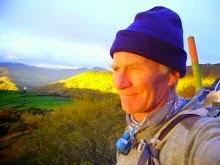
The first ten days I sauntered and socialized my way through the medieval villages , then I climbed up to the meseta, or plateau and unleashed the legs. Days of walking along empty Roman roads and countryside.. Every evening is different, one albergue was like Faulty Towers, the next a warm greeting by nuns, the next a sponaneous samba party.
My companions for ther past three days are, Annette from Berlin and Atracta from Belfast, both speed walkers and despite their knee problems leave me trailing. We cover over 30km a day and expect to be in Santiago in five days. Falling into the routine: on the road by 7am, coffee stop mid-morning, late lunch and find a hostel by early afternoon. Then dinner and party with all the fellow perigrinos we met up with along the way, sadly many have had to drop out or rest because of sprains and strains.
Saturday, November 9, 2013

Monday, October 28, 2013
The Crazy Keroracs of the Camino
It is day 11 and I´m in Burgos. The blisters have morphed into snake skin. My random collection of tweaks, tingles and aches are just another roadside attraction. I try to listen to my body´s whispewrs to avoid screams later on. Many perigrinos have had to drop out because joints turned to jello. I´ve settled down to a steady 25k a day, my 20lb pack is not a problem, although it couls be 5lb lighter if i had the latest adventure wear - that said, nobody dies when you shop at the Sally Ann.
We are like Kerorac´s dhrama bums, meeting up each evening at the next water hole. There was Polish Peter with his 30kilo pack - I told him there are no luggage racks on a hearse, he then served me hot coffee from his pack along with chunk of chocolate. John, the sound engineer from Toronto, Sabrina who has walked from Germany, a 73 year old frenchman whoes has already clocked 3800km this year, a 14 year old Korean girl striding along with her dad. All the wonderful untidiness of humanity stompin´along with a little help from tinto and tynanol.
We are like Kerorac´s dhrama bums, meeting up each evening at the next water hole. There was Polish Peter with his 30kilo pack - I told him there are no luggage racks on a hearse, he then served me hot coffee from his pack along with chunk of chocolate. John, the sound engineer from Toronto, Sabrina who has walked from Germany, a 73 year old frenchman whoes has already clocked 3800km this year, a 14 year old Korean girl striding along with her dad. All the wonderful untidiness of humanity stompin´along with a little help from tinto and tynanol.
Thursday, October 24, 2013
Ballykissangel Country
The Camino could be Ballykissangel country if I wasn´t so totally knackered - ´girls, drink, feck it´as Father Ted would say. I went mad today and hooved 40k over nine hours. The last part refers to the blisters, usually I stomp them into submission by mid-morning, we´ll see tomorrow. Fortunately I have been practicing DIY medicine for years, specializing in pocket knief and duct tape procedures. I´m four days east of Burgos, it´s the end of the first week and 200km are in the dust.
Wednesday, October 23, 2013
Snake in a Bamboo Pole
On the Camino travel is like being a snake confined to a bamboo pole. i stay on the ttrail following the yellow arrows and scallop shells up and down hills, similarily, I have to resist the tempation to go mad and walk all day. The Roman legions rested every fourth day to allow the body to recover. I walk until noon and then kill an afternoon at a side walk cafe with a bottle of Rioja. Aches disappear with the morning mist. Along an empty stretch I got an earworm and relief until myself and fellow perigrinos belting out the Blues brother´s Ghost Riders in the Sky to the rows of grape vines - a mighty herd of red eyed cows a plowin´thru the sky´etc.
I´m haf a day east of Logrono and today´s alberque is a 12th century gothic church fortruss.
I´m haf a day east of Logrono and today´s alberque is a 12th century gothic church fortruss.
Monday, October 21, 2013
Sauntering to Santiago
I had no idea walking was so easy or so much fun. It´s day four and I covered 120km, I went mad yesturday and did 40km, now nursing blisters. Stripped gear down to bare essentials - chopped sleeves off polar fleese and ditched second pair of underwear - ´some folks got more underwear than notches on a gun. I know better than that. A man only needs one. One good pair, it ain´t much, it ain´t much, it´s just every little thing.´ ( with a nod to Janis Joplin).
The first hour or so is a walk in the dark under a harvest moon, later come the cafe and beer stops. In the evening it´s a free-rolling dinner and chat with fellow perigrinos.
The first hour or so is a walk in the dark under a harvest moon, later come the cafe and beer stops. In the evening it´s a free-rolling dinner and chat with fellow perigrinos.
Friday, March 1, 2013
Camino de Santiago photos


Creating Cross-Country Courses
CREATING CROSS-COUNTRY COURSES
Hugh Morshead c2013
Chapter Outlines
Introduction.
Chapter 1: Creating Courses.
Course design is all about heads and toes,
giving horses confidence and keeping them sound. The challenge is how to do
this with the economy and climate swinging on their hinges.
Chapter 2: Good Footing in Bad Weather.
Here are ways to
work with all the vagaries of weather, soil and landscape.
Chapter 3: Rock and Brush.
Rock and brush are
the yang and yin of course building. Stonework gives character and permanency,
while the strength of brush is in its weakness.
Chapter 4: Portable Jumps.
There are three
things on a cross-country course: jumps, fences and obstacles. Jumps are built
with natural materials and look and ride like jumps, fences are built with
milled lumber and obstacles are all the rest. Here are step-by-step
instructions on how to build eleven portable jumps using logs.
Chapter 5: Ditches, Banks and Water Jumps.
Water table fluctuations
and soil dynamics can take the poetry out of course building. Their
construction is not as complicated as perceived. Here are affordable ways to
build these feature fences that will pass the test of time.
Chapter 6: Elvis on Velvet.
Too often, the
pristine natural beauty of a cross-country course becomes two miles of Elvis on
velvet because of the floral extravagances of garden centers. Natural
landscaping looks better, saves cash and is sustainable.
Chapter 7: Safety Depends Upon Risk.
Three things are
unequivocal: horses and risk are inseparable, outdoor conditions are variable
and duty of care is sacrosanct. Ensuring safety is further compounded by sport
being amateur and safety being a professional endeavour. Here are suggestions
and thoughts on how to get it right.
Chapter 8: Chainsaw Carving and other Skills.
Course builders
live in a world of rules, dimensions, deadlines and inspections. Chainsaw
carving is about doodling with the discarded to create the unnecessary. This
chapter also gives insider tips on related matters for the DIY folk.
Chapter 9: Portable Stalls, Show Jumps and Dressage
Rings.
Here are detailed
instructions for building portable stalls, general tips on making show jumps
and some secrets about dressage arena footing.
Chapter 10: The Third Exit Past Sanity.
Every horse show
has the same address – just take the third exit past sanity. Here are ways to
prevent the bad fairy flying over the night before the show and sprinkling all
messed up dust over everything.
INTRODUCTION
Cross-country
courses can cost less to build today than a decade ago, yet the cost to
organizers has skyrocketed. This book is about how to thrive in a changing
world were both the economy and climate are swinging on their hinges. Aligning
endeavours with nature turns these seemingly insolvable problems into
opportunities.
Land stewardship and storm water management
not only mitigate against extreme weather, but they will also improve the
footing when times are good. Design and construction techniques continue to
evolve; these changes are both good and bad. The sharing of knowledge, best
practices and education has removed much of the uncertainties of competition;
the downside is that spectators and sponsors are as much a part of the sport as
are the horses and riders. The prestige expense of packaging events takes cash
away from the critical components, such as, footing and land stewardship.
Natural landscaping amplifies the inherent beauty of the countryside and is
self-sustaining; this frees up cash for jumps.
Jump construction
has seen a shift away from natural logs to milled lumber. The convenience and
versatility of portable jumps cannot be denied. The downside is the originality
of competition sites is eroded by cloned jumps. This book gives instructions
for building eleven rustic portable jumps. They are horse-friendly and easy on
the eye. This book is aimed at horse farms and the organizers of lower level
competitions; my goal is to encourage the less experienced to build jumps. A
good plan is to start with the simple log jumps and then progress to banks,
ditches and water jumps. Knowing what to do and what not to do is as important
as carpentry skills, as is safety, this overarches all aspects of design and
construction.
The challenge is
that equestrian sport is amateur, while safety is a professional endeavour with
trained officials and Emergency Medical Services. These opposites are
reconciled in three ways: rule changes have shepherded the wayward, there is a
general acceptance that safety is everyone’s responsibility and there is awareness
that an active lifestyle with its attendant risks is essential for quality of
life. International riders are a known
quantity, the lower levels ride on the margins of ability. The subtleties of
course design can play a significant role in giving the wobblers an unseen
hand.
Finally, horse
shows are as much about people as they are about horses. Success or failure
depends upon the people putting it all together, rather than the budget or
attributes of the site. It is a shared commitment by a team working under
stressful conditions – and there’s the rub. I call it the Faulty Towers paradox
– you have to be mad to run a horse show, but if you’re mad, you cannot run
one. Here is a look behind the scenes and suggestions for staying on the sunny
side of sanity. It is also a glimpse
into the slightly feral world of the course builder. At the heart of designing
and building cross-country courses is the satisfaction of creating things. It
is as much fun makes jumps as it is galloping over them and that is why I hope
more people will have a go at building jumps.
Note: I will post
a chapter every two or three weeks as revisions are completed. Comments are
welcome and encouraged.
Subscribe to:
Posts (Atom)